
Table of Contents
Google’s first page for “nextjs web design agency” is mostly studio homepages. Subeleven talks about working directly with the developer who ships the site. FocusReactive talks about audits, App Router versus Pages Router, and a CMS list. Increasio leads with Next.js 16, Turbopack, and a Vercel partnership. Those pages are useful if you already decided you want a React shop for a product company.
They skip the decision a Chicago service business actually has to make. A Wicker Park restaurant, an Oak Park electrician, and a River North accounting firm do not need a 20-week platform rebuild by default. They need a fast public site, a CMS the office manager can use, and a contract that says who owns the code when the project ends.
IntuiCo Digital runs Next.js in production on intuicodigital.com. WordPress sits behind it as a headless CMS. The public site is Next. Editors still publish blog posts in WordPress. That setup is why this guide exists: we use the stack, and we will tell you when not to buy it.
What a Next.js web design agency actually does
A Next.js web design agency designs and engineers a website on Next.js, the open-source React framework maintained by Vercel. The shop should be able to explain, in writing:
- which templates are static, which are server-rendered, and why
- which CMS the marketing team will log into after launch
- how Googlebot gets HTML instead of an empty JavaScript shell
- who hosts the site, what it costs per month, and whose name is on the accounts
A Squarespace reseller with Next.js added to a capabilities list does not qualify. Neither does a design studio that hands Figma files to a freelancer and hopes Core Web Vitals work themselves out.
The shops currently ranking for this query get several things right. Steal those, then keep going.
Subeleven’s process is Discovery, Build, Optimize, Support. That sequence is the right skeleton. They also talk about Lighthouse scores, headless CMS work, and WordPress-to-Next migrations. If you are leaving a slow theme, migration skill matters more than a new homepage mockup.
FocusReactive’s page is the longest of the three, and it is the one to beat on completeness. They audit before they write code. They ask whether App Router or Pages Router is the right fit for the codebase in front of them. They list production CMS work with Sanity, Storyblok, Contentful, Prismic, and Payload. They separate project types: audits, ecommerce, content platforms. Their published ranges, 6 to 12 weeks for a marketing or content site and 12 to 20 weeks for a heavier build, are honest about content modeling. React components are rarely the part that takes four months.
Increasio sells current-version expertise: App Router, Turbopack, Partial Prerendering, Server Components. If you are hiring for a large application, version fluency is a real filter. A team stuck on patterns from 2022 will spend your money relearning the framework on your dime.
What none of those pages do well is talk to a Midwest owner who still has to answer phones. The rest of this guide is that conversation: when the stack is worth it, when a managed WordPress site is the better product, what a quote should include, and how to score the people you are about to pay.
When Next.js is the right stack for a Chicago or Midwest business
Next.js earns its keep when the public site has to be fast and the content has to change without a developer ticket for every headline.
Fits we actually see:
- A professional-services firm with a large resource library, staff bios, or several location pages that must stay indexable
- A multi-location trade company (HVAC, roofing, electrical) that needs unique pages per service and neighborhood without a four-second mobile load
- A restaurant group with more than one concept, reservation links, and a menu the GM updates at 4 p.m.
- A brand that already likes WordPress as an editor but hates what a heavy theme does to phones
- Ecommerce that outgrew a theme and needs a custom storefront on top of Shopify or another backend
Next.js can pre-render HTML, stream server components, and cache pages at the edge. Google’s crawler receives real content. Images can be resized at request time. Metadata, sitemaps, and redirects live in code instead of a pile of plugins fighting each other.
A Next.js site stuffed with unoptimized client JavaScript will fail Core Web Vitals the same way a bloated WordPress theme does. The agency’s job is to pick rendering per route and keep the JavaScript budget honest.
If your buying journey is a homepage, three service pages, and a form, you may not need any of this. Read the next section before you send RFPs.
When you should not hire a Next.js web design agency
This is the part the ranking pages leave out.
Skip Next.js if you need a two- or three-page brochure, you want to edit it yourself in a visual builder, and you do not have a developer on staff after launch. IntuiCo’s managed website plans start at $199 per month plus a setup fee for exactly that job. They use WordPress with a preset design, hosting, SSL, and a small monthly edit allowance. Forcing that project onto Next.js adds a repo, a hosting bill, and a person who has to maintain Node.
Skip it if the only goal is “make the Wix site nicer.” You can get a cleaner WordPress site or a custom build without a React runtime. Our web design plans exist for that scope.
Skip it if nobody on your side will own content. Headless architecture assumes someone writes and publishes. If the owner still sends homepage copy as a Facebook message, the CMS choice will not save the project.
Skip it if you need a native mobile app, not a website. Next.js is for the web.
A River North law firm with 40 attorney pages, a blog, and a lead form is a Next.js conversation. A single-truck plumber who needs hours, a service area, and click-to-call is usually not. We would rather sell the smaller plan than bolt a framework onto a site that will not use it.
The Chicago website design page publishes the managed versus custom split so you can do that math before a sales call.
SEO and Core Web Vitals, in plain English
People hire a Next.js shop because they heard it is “good for SEO.” The useful version of that sentence is narrower.
Google ranks pages that help the searcher and that work on a phone. Core Web Vitals are Google’s field metrics for that phone experience:
- Largest Contentful Paint (LCP): how quickly the main thing on the screen appears. Aim for 2.5 seconds or faster for most users.
- Interaction to Next Paint (INP): how quickly the page reacts after a tap. Slow menus and third-party chat widgets wreck this.
- Cumulative Layout Shift (CLS): whether the layout jumps while it loads. Unsized images and late-loading fonts are the usual culprits.
Next.js helps when the agency uses it to send HTML quickly, size images, and avoid shipping a huge client bundle to a homepage that is mostly text and a form. It does not replace titles, headings, internal links, or local relevance. A fast blank page still loses to a slower page that names the service and the neighborhood in the first screen.
If you already have search traffic, a rebuild has to protect URLs. Redirects, canonicals, and analytics belong in the proposal, not as a week-four surprise. That work sits next to SEO, not instead of it. A framework will not invent reviews, service-area pages, or copy that matches what people type.
Ask the agency to show Lighthouse or Chrome User Experience Report data on a site they shipped, on mobile, not a localhost screenshot. Then ask what they will measure on yours 30 days after launch. A shop that cannot name LCP, INP, and CLS without opening a blog post is not a Next.js specialist.
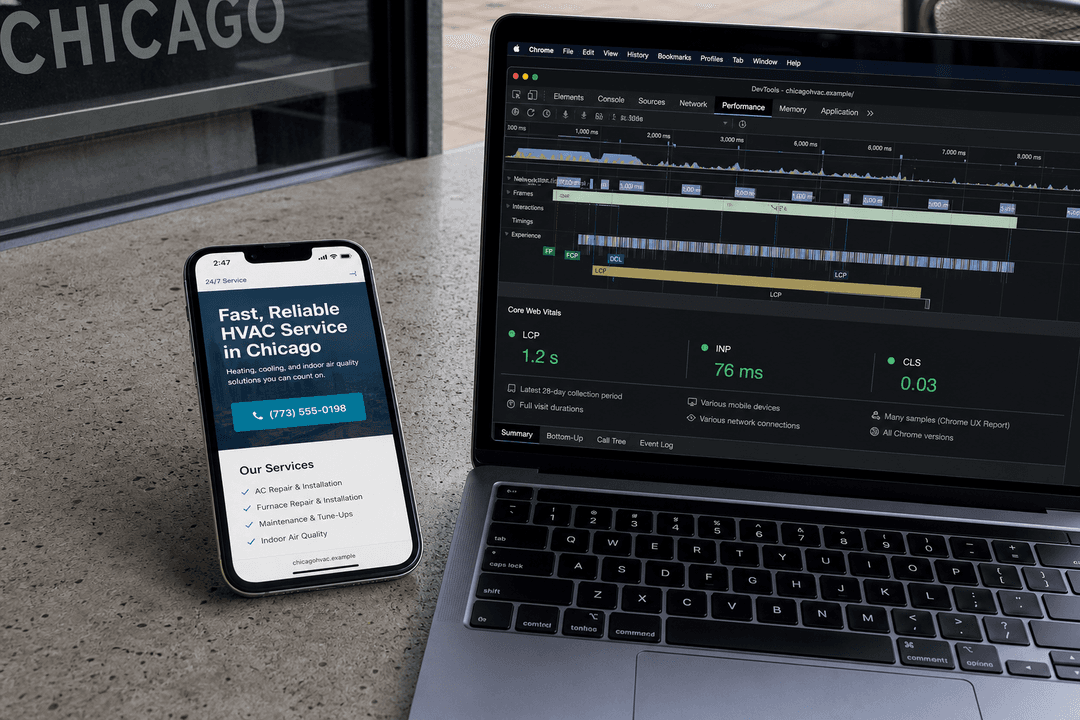
For a Lincoln Park HVAC company, the first screen on a phone should paint the headline, the proof, and the call button before the visitor thinks about leaving (LCP). The call button should respond on the first tap (INP). The phone number should not hop down after a banner loads (CLS). If the agency cannot connect those three letters to that screen, keep shopping.
Headless CMS: the login your staff will actually use
FocusReactive is right that the CMS decision is as big as the framework. Marketing sites fail in year two because the editor is hostile, not because a new React version shipped.
Sales calls usually name Sanity, Storyblok, Contentful, Prismic, or Payload. Sanity and Payload suit teams that want a custom, structured studio. Storyblok and Prismic suit marketers who want a visual editor. Contentful shows up in multi-brand catalogs. WordPress as a headless CMS is the other common path: the editor most office managers already know, with the public site on Next.js.
IntuiCo uses the last option on our own site. WordPress holds posts. Next.js renders the public pages and proxies /blog so the URL a reader sees is on www.intuicodigital.com, not on the CMS host. Editors do not log into Vercel to fix a typo. That is the point of headless: the public site can be fast while the writing tool stays familiar.
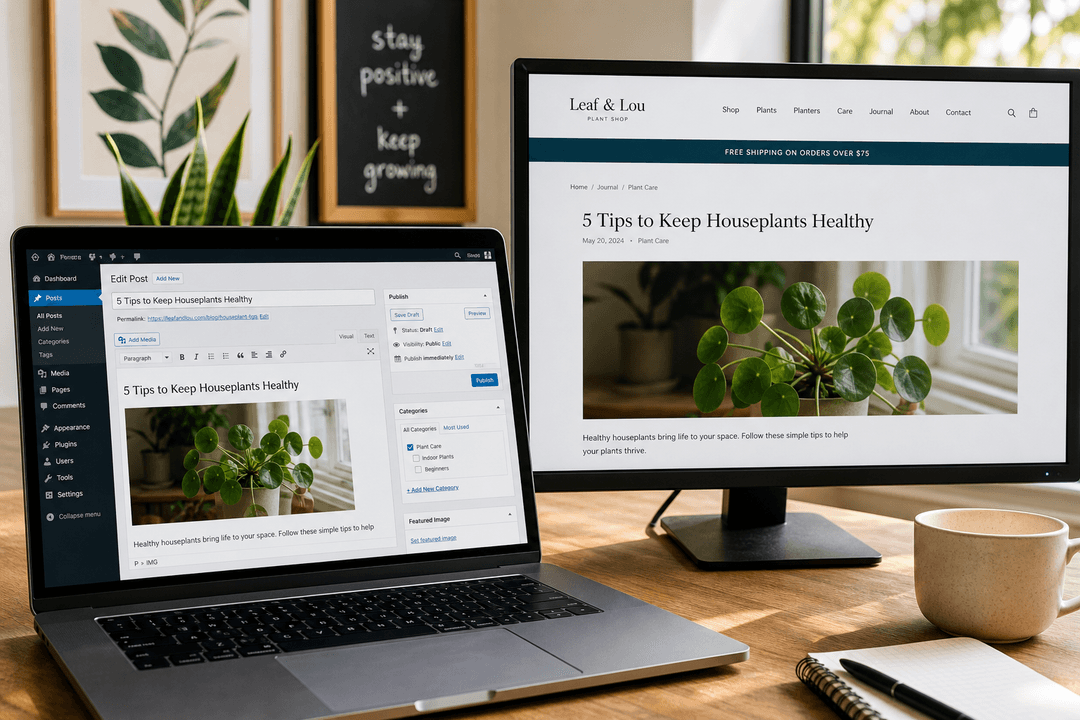
Whatever CMS they propose, make them demo four things on a screen share:
- a draft, a preview link, and a publish
- what happens to the live page after publish (full rebuild, on-demand revalidation, or cache purge)
- who can change a URL, and whether that change creates a redirect
- how alt text, titles, and share images get filled so you are not pasting into five plugins
If the answer to “the GM needs to change Saturday hours” is “open a ticket,” you bought a brochure, not a CMS.
For a Wicker Park restaurant, that demo should look like this: the manager edits brunch hours in the CMS, hits publish, and the public page updates without a theme rebuild and without a developer on Slack. If the agency cannot show that loop, they are selling you a custom app you will be afraid to touch.
White-label arrangements show up here too. Subeleven will build under another agency’s brand. That can work if you know you are paying a front agency that subcontracted a studio. It does not work if you find out during an outage that nobody on the call wrote the code.
App Router, Pages Router, and the questions that sort real shops from keyword lists
You do not need to become a React engineer. You do need to hear a specific answer.
Ask whether new work uses the App Router. It has been the Next.js default for years. A team that still starts every project on the Pages Router should explain why. Sometimes there is a reason: an existing codebase, a library that has not caught up, a short-term patch. “It is what we know” is not a reason you should pay for.
Ask how they pick static generation, server rendering, incremental revalidation, or partial prerendering per template. Increasio’s pitch around Turbopack and Partial Prerendering is current. The useful test is whether they can point to a live route and say this one is static because the copy changes monthly, and this one is dynamic because it reads inventory.
Ask what they will do with an old Next.js app if you already have one. FocusReactive’s audit-before-build habit is the right default. Migrating Pages Router to App Router is a project, not a toggle.
Ask where it hosts. Vercel is the path of least resistance and the one official partners talk about. AWS, Cloudflare, or a Node host can work. The proposal should name the vendor, the estimated monthly cost at your traffic, and whose credit card is on the account. “We handle hosting” without a dollar figure is how surprise bills start.
Ask about preview URLs. Every content change should produce a link you can tap on your phone. If the first time you see the site is launch day, the process is broken.
What a Next.js web design agency should put in the quote
A number without a page list is a guess. The quote should read like a build sheet.
- Page inventory and unique templates. Homepage, service, location, blog index, blog post, legal, 404. “Up to 10 pages” is not an inventory.
- Design source. Custom, from a system they already have, or from your Figma. Revision rounds in writing.
- CMS and content model. Content types, who migrates old copy, who writes new copy, who trains your staff.
- Integrations. Forms, CRM, booking, ecommerce, analytics, chat. Each named, not “and other tools.”
- Performance budget. Target LCP, INP, and CLS. Image strategy. Which third-party scripts are allowed on the homepage.
- Search migration. Redirect map, metadata, sitemap, robots, Search Console, analytics. If you have rankings, this section is not optional.
- Hosting and environments. Production, preview, who pays, who has access, what happens at traffic spikes.
- Ownership. Git repository, design files, CMS space, domain, third-party keys. All in your name, or a written transfer process with a date.
- Timeline with your dependencies. Content due dates. What happens if copy is late. Who is blocked.
- Support after launch. Hours, response time, Next.js and dependency upgrades, content training.
Published ranges elsewhere are wide because the work is wide. Increasio publicly starts a Next.js marketing site around $4,000. FocusReactive’s 6-to-20-week windows imply a much larger check for anything with commerce or localization. IntuiCo custom website builds start at $2,500 plus a monthly care plan from $199, and a Next.js project sits in that custom bucket, not on the $199 managed plan. If a bid is far below those floors for a real Next.js build, read the exclusions. Someone is omitting CMS, migration, or the months after launch.
Ask who writes the code. Subeleven makes a point of putting you with the person who ships it. That is a fair test. If the sales call is three account managers and the engineer is “on another pod,” ask to meet the engineer before you sign.
Code ownership is the clause people skip and then regret. You want a GitHub or GitLab repository you own, CMS and hosting accounts in your name, licenses in your legal name, documentation a different developer can follow, and credentials handed over at launch rather than held against a retainer. If the shop keeps the site on their server with no export path, you are renting. That can be fine for a managed WordPress plan where hosting is the product. It is a poor fit for a custom Next.js codebase you will still need in five years.
A process that actually finishes
Steal the useful parts of the ranking pages and ignore the slogans.
Discovery or audit. Goals, audience, current URLs, analytics, CMS, hosting, success metrics. For an existing Next.js app, this is a technical audit. For a new site, it is a scope workshop. IntuiCo’s Chicago process starts the same way: pages, features, content, decision-makers, budget, date.
Architecture before components. Route map, content model, rendering choices, design system or Figma. Agree this before anyone builds forty cards that all have to change.
Build on preview URLs. Weekly reviews against the approved scope, not against a moving mood board.
Optimize. Core Web Vitals, form tests, accessibility basics, redirects, metadata. Subeleven’s Optimize stage is this work. It should be scheduled, not leftover time if the build happens to finish early.
Support. Dependency upgrades, content help, small experiments. Name the monthly cost. Increasio publishes retainer and hourly options. You want the same clarity even if you hire someone else.
A small marketing site with copy ready can ship in a few weeks. Content platforms with a new CMS often take 6 to 12 weeks. Commerce, multi-language, or a messy migration can take 12 to 20. IntuiCo’s simpler WordPress sites often land in two to three weeks after content is ready. Do not compare a five-page managed plan to a headless rebuild. They are different products. If copy is late, the calendar slips. Put that in the proposal so nobody pretends the agency is slow when the menu PDF never arrived.
How IntuiCo runs Next.js with headless WordPress
This is the production setup on intuicodigital.com, not a slide.
The public site is a Next.js application. Service pages, location pages, and the rest of the marketing site render through that app. Blog content is written in WordPress. Requests to /blog on the public domain are proxied so readers never have to know the CMS hostname. We keep internal links on the public www host on purpose. Search engines and humans should see one site.
Why that split:
- Writers already know WordPress. Drafts, scheduled posts, media, and SEO fields sit where they expect.
- The marketing pages can stay light. They do not inherit a theme’s plugin pile.
- We can cache and render routes differently. A service page and a blog post do not have the same freshness needs.
- If WordPress is slow or takes a bot flood, the rest of the site does not have to go down with it.
That is one pattern, not the only pattern. A restaurant group might be happier in Sanity. A catalog brand might want Shopify plus Next.js. The filter is the same: the public site should be fast, and the people who change copy should not need a pull request.
If your project is a standard local brochure, we will point you at a managed WordPress plan on the web design page instead. Next.js is the right recommendation when the site has enough templates, traffic, or integration work to justify a real engineering project. We would rather keep you on the $199 or $399 plan than sell you a stack your staff will not use.
Selection scorecard
Print this. Score each agency 0, 1, or 2 on every row. Multiply by the weight. Add them up. A shop that cannot produce a repo they will hand you, a CMS demo, and mobile field data should not win on a mood-board.

| Criterion | Weight | What a 2 looks like |
|---|---|---|
| Relevant work | 5 | Live Next.js sites for businesses like yours, not only SaaS dashboards. Ask for a Midwest service or content site if that is you. |
| Technical honesty | 5 | They can explain App Router versus Pages, rendering per route, and a CMS they have shipped. Vague “we do React” is a 0. |
| CMS your staff can use | 4 | Demo of draft, preview, publish. Training in the quote. |
| Performance proof | 4 | Field data on a shipped site. A plan to measure yours after launch. |
| SEO and URL care | 4 | Redirects, metadata, sitemap, analytics named in the proposal. |
| Ownership | 5 | You own git, CMS, hosting, domain, and keys. Transfer language in the contract. |
| Quote completeness | 4 | Page list, integrations, hosting cost, support, exclusions. |
| Process and calendar | 3 | Written stages, your content dates, weekly previews. |
| Support after launch | 3 | Named retainer or hourly, including framework upgrades. |
| Fit for Chicago and SMB work | 3 | They talk about calls, service pages, and the people who edit the site, not only design systems. |
Maximum score is 80. Treat anything under 50 as a no. A beautiful presentation that scores 0 on ownership and CMS is a future rebuild you will pay for twice.
Run these in the sales call:
- Who is the engineer on the account, and will I talk to them before we sign?
- Show me the CMS a marketer would use on a site you shipped last year.
- What is the monthly hosting and maintenance number at my traffic, in dollars?
- What happens to the repository if we stop paying you?
- For my five most important current URLs, what is the redirect plan?
- When would you tell me not to use Next.js?
If they never talk you out of the framework, they are selling hours. A shop that will put a Lincoln Park contractor on a $199 WordPress plan instead of a headless rebuild is the one you can trust when they do recommend Next.js.
Send the same brief to two shops this week
Send two or three agencies the same packet: current site, required pages, who edits content, must-have integrations, target date, and whether existing URLs must stay. Ask for a written scope. Score the replies with the table above.
If you want IntuiCo in that set, start with the Chicago website design page for published plan prices, or the web design page for managed versus custom. Next.js work is custom. If the right answer is a smaller WordPress site, we will say so on the first call.
Send the brief through the contact form. Include the current domain and the pages that already get search clicks.