Table of Contents
A Lincoln Park general dentist and a Naperville pediatric office can buy the same "dental website design" package and get very different results. One needs emergency capacity, implant pages, and a phone number that works at 9 p.m. The other needs new-patient forms, insurance language parents can scan on a phone, and a map that matches the Google Business Profile. National dental shops selling the same template to both practices skip that split.
Google is already sending IntuiCo impressions for dental website queries. The service page at dental web design is the hire page. This guide is the checklist to run before you sign, including when a managed plan is enough and when you should pay for a custom build.
The pages currently ranking for "dental website design services" are mostly sales homepages. Lasso MD sells custom builds, yearly redesigns, and a four-to-eight-week timeline. Star Hawk Studio argues against template farms and for procedure-specific WordPress pages. Those points are fair. They still leave out the Midwest owner who has a front desk, a practice-management login, and a budget that is not a DSO marketing department.
The website's job is booked visits, not a prettier logo
A dental site has one job: help the right person choose you and request a time. Pretty photography helps only if the rest of the page answers the questions people already have.
Those questions are local and specific:
- Do you take my insurance, or do you explain cash and membership options in plain language?
- Can I book after the office closes, or do I have to wait for someone to call me back?
- Are you the implant, Invisalign, emergency, or family practice I searched for, or a generic "full service dentistry" page?
- Is the address, phone, and name the same as the listing I just saw on Google?
- Will this load on a phone in a parking garage off Clark Street, or only on office Wi-Fi?
If a proposal talks about "brand storytelling" and never names those five items, you are shopping for a brochure.
IntuiCo Digital is a Chicago company at 67 E Madison Street. We design sites for service businesses across Chicago and the Midwest, including Naperville and the Quad Cities. We do not publish dental patient-conversion percentages we cannot show. What we can show is the page list, the booking decision, the pricing on the dental web design page, and the process we already use on Chicago website design.
Start with a page inventory, not a homepage mockup
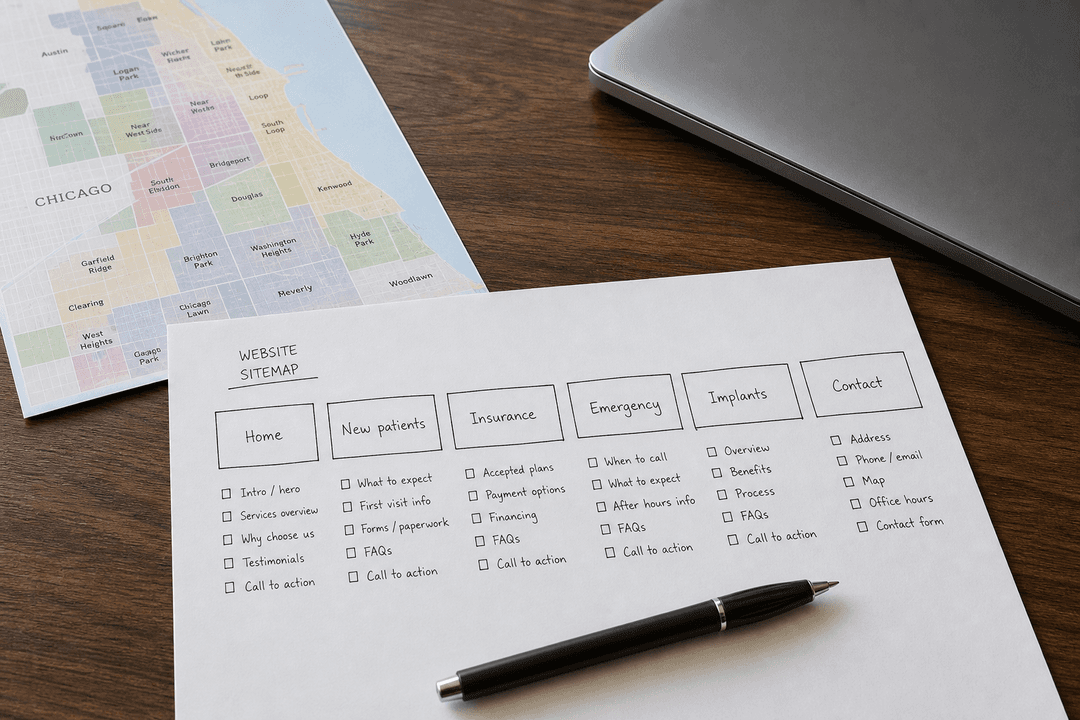
Template dental sites fail in a predictable way. They ship a homepage, an About page, a vague Services grid, and a Contact form. High-intent searches are for procedures and situations: emergency tooth pain, dental implants, Invisalign, pediatric first visit, second-opinion crowns. Those need their own URLs.
Write the inventory before anyone opens Figma.
Core pages almost every practice needs
- Home: who you are, the area you serve, the next step (call or book), and proof a stranger can verify
- New patients: hours, what to bring, parking or CTA access, first-visit steps
- Insurance and fees: accepted plans, what you do if you are fee-for-service, financing if you offer it
- Team: real names, credentials, and photos. Skip stock smiles.
- Contact: NAP (name, address, phone) that matches Google, embedded map, after-hours instructions
- Privacy and accessibility notes for forms
Procedure pages that earn the ranking
Build a page per service you actually want to rank for. A River North cosmetic practice and a Rock Island family office will not share the same list. Typical high-intent pages:
- Emergency dentistry
- Dental implants (and All-on-X only if you do that work)
- Invisalign or clear aligners
- Veneers or cosmetic dentistry
- Pediatric dentistry
- Periodontics, endodontics, oral surgery, if those are in-house rather than referred out
Each procedure page should say who it is for, what the visit looks like, how long it takes, what happens next, and a single call-to-action. Star Hawk is right that an implants page and an emergency page should not share the same layout. An emergency visitor is in pain and wants a phone number. An implant visitor is comparing experience, photos, and a consult form.
Location pages, only when they are real
If you have one office, do not clone "dentist in Lincoln Park," "dentist in Lakeview," and "dentist in Wicker Park" with the same paragraph. Google treats that as doorway junk. One honest office page plus neighborhood language on the homepage is cleaner. Multi-location groups should give each office its own NAP, hours, parking notes, and unique photos.
Hand this inventory to every vendor. If two quotes are for "a five-page website" and you listed twelve URLs, the quotes are not comparable. The how to choose a Chicago web design company scorecard is the same idea, pointed at dental scope.
Booking, forms, and the person who answers the phone
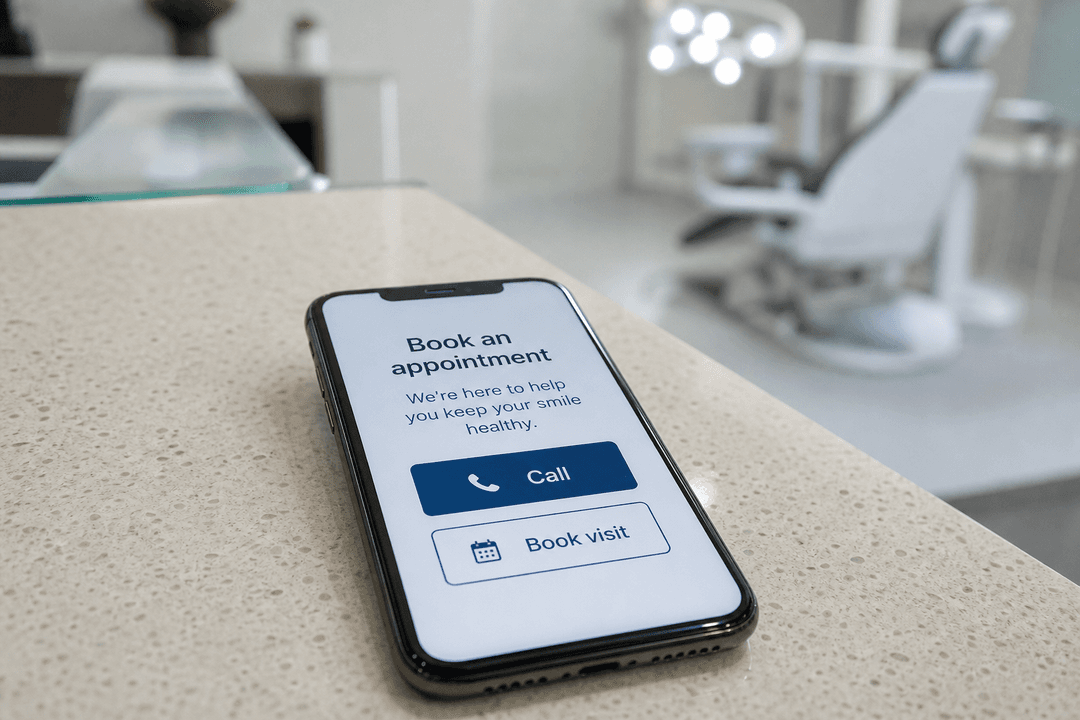
Online scheduling is not a widget you drop in during week six. It changes who owns the calendar.
Ask, in writing:
- Does the site connect to the system you already pay for (Open Dental, Dentrix, Eaglesoft, or a layer like NexHealth or Weave), or is it a separate calendar someone has to babysit?
- Who confirms the appointment: an automated message, the front desk, or both?
- What happens to after-hours requests on a Saturday?
- Are health-history forms collected on the site, in the PMS patient portal, or as a PDF the office still prints?
A Chicago practice that lives on the phone can do well with click-to-call, a short form, and a promise to respond the next business morning. A practice that wants nights-and-weekends capture needs real availability rules, or the "Book now" button becomes a complaint generator.
Do not let a designer pick the scheduler because it looks modern in a demo. The office manager who already fights the PMS should sit in that meeting.
Forms that collect clinical detail need a vendor who will sign a Business Associate Agreement if they store or transmit that data. IntuiCo can build the public site and connect a scheduler. HIPAA scope belongs in the proposal, not in a blog FAQ. If a shop shrugs at that sentence, keep walking.
Local search, without turning the website into a Google Business Profile project
Dentists get found on Maps and in organic results. The website still has to agree with the listing.
Match the legal or public-facing practice name, street address, and phone number to the Google Business Profile, exactly. If the site says "Smile Studio Chicago" and the listing says the dentist's personal name, you make Google guess. Put the same NAP in the footer of every page. Link to the Maps listing. Do not build a second, slightly different address block in the header "for design reasons."
On-page search work for a dental site is boring and specific:
- A unique title and H1 per procedure page, written the way a patient searches ("dental implants in Naperville"), not "Our Services: Implants!"
- Internal links from the homepage to the procedures you care about
- Image filenames and alt text that describe the photo (the operatory on Dearborn, the team at the front desk), not "image1"
- A sitemap submitted in Search Console after launch
- Schema that matches the real business type. If a vendor cannot explain Dentist or LocalBusiness markup without opening a plugin settings screen, they are guessing.
Broader ranking work (reviews, citations, content over months) is SEO, not a one-time design invoice. Managed website plans at IntuiCo include basic on-page SEO and Google Business Profile setup. They do not include a guaranteed Map Pack slot. Nobody honest sells that guarantee.
If the current site already gets search clicks, a rebuild has to protect URLs. Inventory the live pages, map redirects, and keep the implant URL if it already attracts traffic. The Chicago website redesign guide is the process for that. Skipping redirects is how a "new brand" launch quietly drops the queries you already earned.
Phones, speed, and photos you actually own
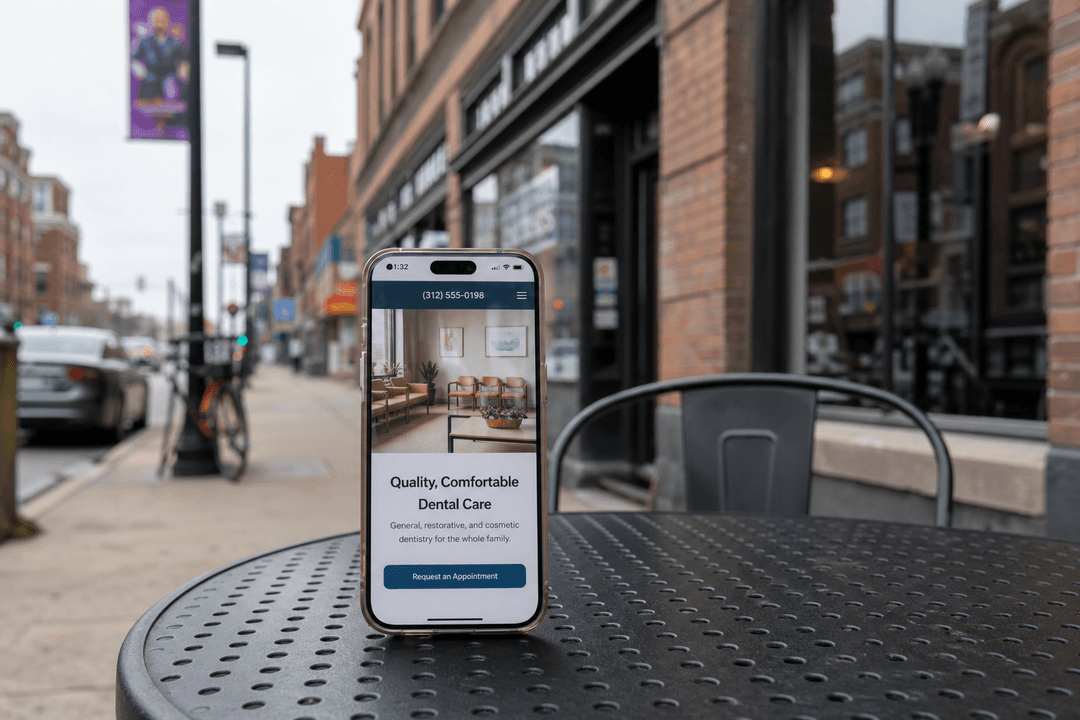
New-patient research happens on a phone in a lot of cases. You do not need a made-up percentage to test your own site: open it on cellular data, standing outside the office. Try to find the phone number, the next available action, and the insurance paragraph with one thumb.
Google's Core Web Vitals are the field metrics that describe that phone experience:
- Largest Contentful Paint: the main thing on the screen should appear quickly. A full-bleed hero video of a smiling stranger is a common way to fail this.
- Interaction to Next Paint: the call button and menu should react on the first tap.
- Cumulative Layout Shift: the phone number should not jump after a banner or cookie bar loads.
Dental photography is a rights problem as much as an aesthetics problem. Own the files. Get written patient consent for clinical photos. Do not scrape before-and-afters from a vendor's other clients. A Midwestern practice with honest operatory photos and a readable fee page will beat a template full of California stock models that do not match the waiting room on Madison Street.
Ask the agency to show mobile Lighthouse or CrUX data on a site they shipped, not a localhost screenshot. Then ask what they will measure on yours 30 days after launch.
Honest pricing: managed plan versus custom dental build
National dental shops quote wide ranges and leave the Midwest owner to guess. IntuiCo publishes the numbers. They live on the dental web design page and the Chicago website design cost guide.
Starter Website Plan: $199 per month plus $199 setup, 12-month agreement. Two to three pages, preset design, hosting, SSL, contact form, basic on-page SEO, Google Business Profile setup, maintenance, and up to 30 minutes of content edits per month. Monthly edit time is for content, not a new visual design.
Growth Website Plan: $399 to $599 per month plus $299 setup. Up to four or five pages, plus an AI chatbot and Google Analytics, and up to 60 minutes of monthly edits.
Custom Website Build: from $2,500, plus a monthly care plan from $199. This is the bucket for unique design, a full procedure-page inventory, booking integrations, and a conversion-focused build.
A solo family dentist who needs home, about, services, and contact can start on a managed plan. A practice that wants emergency, implants, Invisalign, new patients, insurance, team, and a live scheduler is a custom project. Forcing that second practice onto a two-page preset is how you pay twice.
Lasso MD's four-to-eight-week custom timeline is in the same neighborhood as other serious dental builds. IntuiCo's simpler WordPress sites often launch in two to three weeks after scope and content are ready. Procedure libraries, PMS integration, and late copy stretch that. Put content due dates in the proposal so a late insurance PDF is not billed as "the developer is slow."
If a dental franchise quote is $15,000 and IntuiCo's custom floor is $2,500, read the exclusions on both. Someone is omitting photography, copy, redirects, training, or the year after launch. First-year cost is the useful number: setup plus twelve months of hosting, edits, and the scheduler you still pay separately.
Template mills, "1,000 dental clients," and what to ask instead
Star Hawk's warning about agencies that run a thousand lookalike dental accounts is the right filter. A shared theme with your logo swapped in will look fine in a PDF. It will not give you a unique implant page, unique metadata, or a booking flow that matches your office.
Questions that sort a mill from a builder:
- Will I get a unique template per procedure type, or one "service" layout repeated?
- Who writes the first draft of copy, and is that in the fee?
- Show me two live dental or healthcare sites, on a phone, and tell me what you actually built.
- Where does the site live, and whose name is on hosting, domain, Search Console, and analytics?
- What happens to the files if we stop paying a retainer?
IntuiCo's public dental page lists sample work across industries. If a vendor cannot show a dentist site, ask for a close substitute: another appointment-driven healthcare or local-service build with service pages, forms, and a phone-first home page. "Featured client" can mean a logo on a slide. Open the live URL.
Ownership: domain, photos, code, and the PMS login
Keep the domain registrar, Google Business Profile, Google Analytics, Search Console, and advertising accounts in the practice's name. Give the agency access. Do not transfer the Google login to a vendor as a "convenience."
The contract should say who owns:
- Design source files
- Theme or custom code
- Photography and drone footage
- Copy
- Scheduler configuration
- The CMS
A managed WordPress plan where hosting is the product can keep the site on the agency's stack. That is fine if the agreement says how you export content and what a move costs. A custom build you expect to keep for five years should live in accounts you control, with a handoff date in writing.
A process that finishes in a real office
Steal the useful sequence. Ignore slogans.
- Scope. Current site, required pages, PMS and scheduler, who writes copy, who approves insurance language, budget, date. IntuiCo's Chicago process starts here.
- Inventory and content. Page list, redirects if you are rebuilding, photo list, consent forms for clinical images. Design does not start while the implant page has no draft.
- Build on a preview URL. Weekly reviews against the approved page list, not against a mood board that keeps growing.
- Connect booking and tracking. Test a dummy appointment. Test the form on a phone. Confirm Analytics and Search Console before launch day.
- Launch checks. NAP, click-to-call, hours, SSL, redirects, sitemap, 404s, and the after-hours message.
- Support. Named monthly minutes or a care plan. Plugin updates and backups are not optional on a site that collects patient requests.
A Quad Cities practice with copy ready can move fast. A multi-doctor group arguing about the fee page will not. The calendar should say so.
Score the vendors on paper
Print this. Score 0, 1, or 2. Multiply by the weight.
| Criterion | Weight | What a 2 looks like |
|---|---|---|
| Procedure-page plan | 5 | Written URL list that matches the services you sell, not "up to 8 pages" |
| Booking fit | 5 | Named integration with your actual PMS or scheduler, plus after-hours rules |
| Mobile proof | 4 | Live phone test of a shipped site; a plan to measure yours after launch |
| Local consistency | 4 | NAP matches the Google listing; unique titles; redirect plan if you already rank |
| Ownership | 5 | Domain, GBP, analytics, and files in the practice name, with a transfer clause |
| Pricing clarity | 4 | First-year total, monthly care, scheduler fees called out separately |
| Content plan | 4 | Who writes, who supplies photos, what happens if copy is late |
| HIPAA and forms | 3 | Clear statement of what they store, and a BAA if they store protected data |
| Support | 3 | Named response time and edit allowance after launch |
Maximum is 74. A gorgeous mood board with a 0 on ownership and booking is a rebuild you will buy again.
Send one brief to two shops
Send the same packet to IntuiCo and one other firm: current URL, the page inventory, PMS name, must-have booking behavior, photos you already own, target date, and whether existing URLs must stay. Ask for a written scope.
If the right product is a two-to-three-page managed site, say that. IntuiCo would rather put a small office on the $199 plan than sell a custom stack the front desk will not touch. If you need procedure pages and a live scheduler, that is custom work on the dental web design page.
Use the contact form, call 312-661-5726, or email hello@intuicodigital.com. Include the current domain and the three pages that already get phone calls.