
Table of Contents
If Google Analytics shows sessions climbing and the phone stays quiet, the report and the week disagree. Plenty of people arrived. Too few of them came to hire you.
This shows up constantly on Chicago service sites we rebuild and on sites that come in for SEO. HVAC companies in Lincoln Park. Dentists in Naperville. Law firms downtown. The report looks healthy. The week does not.
Google’s own helpful content guidance asks whether a page would still help someone who arrived without search. Apply that to your homepage. If a stranger from Lakeview cannot tell what you do, where you work, and how to reach you in a few seconds, more blog posts will not save the month.
The rest of this piece is the audit we run before we talk about a full Chicago website redesign. Keep the slug you already rank for. Change the pages that actually get the clicks.

Start in Search Console, not in Figma
Open Google Search Console. Last 28 days. Pages report, then Queries. Sort by clicks.
Write down the five URLs that bring the most organic traffic and the queries attached to each. You are looking for a mismatch, not a traffic total.
A page getting clicks for “how much does a water heater cost” will not behave like a page getting clicks for “water heater install near me.” One person is shopping for a DIY weekend. The other wants a truck this week. Same industry. Different job.
Do the same split for local terms. “Best Italian restaurant Chicago” is research. “Italian restaurant Lincoln Park reservation” is closer to a booking. “Emergency plumber Wicker Park” is a call if the page makes calling easy.
If most of your clicks sit on informational queries and thin blog posts, the site can look busy while lead generation stays flat. That is a targeting problem. You still fix the landing pages, because even the right query dies on a vague first screen. You do not pour more content on top until you know which URLs are supposed to produce calls.
GA4 helps after that. Filter organic traffic. Look at those same five landing pages for engagement and, if you set them up, click-to-call and form events. A page with decent time-on-page and almost no conversions has a conversion leak. A page with a bounce in a few seconds has a promise leak: the result they clicked did not match what they saw.
The searches that bring lookers vs buyers
High-volume terms feel productive because they fill a dashboard. “What is SEO,” “website design ideas,” and “how to get more customers” pull numbers. They rarely pull a booked job.
The queries that pay a Chicago service business are shorter, more local, and less pretty in a keyword tool:
- service + neighborhood or suburb (“roof repair Oak Park,” “med spa River North”)
- service + near me, with a Google Business Profile that actually matches the site
- service + city + a buying word (install, repair, emergency, appointment, quote)
- brand + reviews, once people are comparing you to two other shops
We wrote a longer version of this split in From questions to conversions. The practical move is to map each money service to a dedicated URL, then rank that URL for the hire-now language, not the encyclopedia language.
Local pack still matters. A lot of “near me” clicks never hit your blog. They hit the map. If the website and the profile disagree on hours, service area, or phone number, people bail. Pair the site work with Google Business Profile optimization and the walkthrough in Own the local pack.
AI Overviews now answer a chunk of definition-style questions without a click. Google has been explicit that pages written mainly to catch search traffic, rather than to help the person who lands, are the ones their systems try not to reward. The visitors who still click through in 2026 have less patience. They already saw a summary. Your page has to confirm, in the first screen, that you do the job in their area.
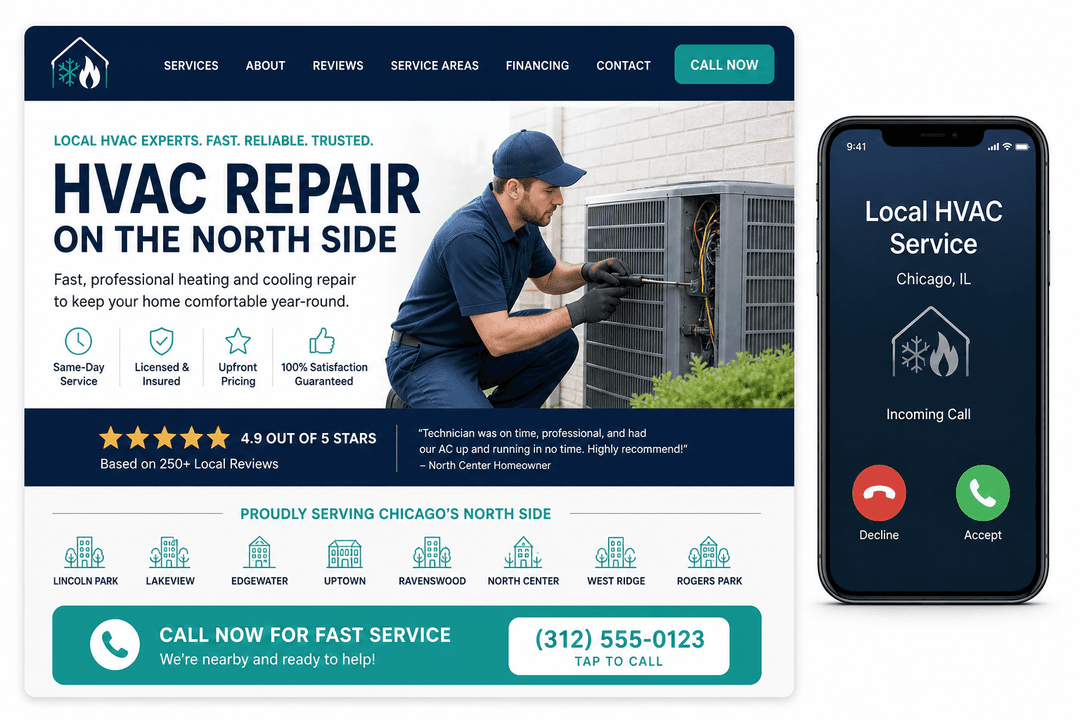
The first screen on the homepage and the service pages
Most quiet-phone sites fail in the same place: the first screen on mobile. Headline, proof, and a way to call. That is the whole job of above-the-fold.
Write the headline as the job plus the place. “Same-day AC repair in Chicago’s North Side” tells someone in Ravenswood they can stop scrolling. “Quality solutions for modern living” tells them nothing. We see the second version on sites that spent real money on design.
Under the headline, put proof a stranger can check. Star rating and review count. Licensed and insured, if that is true in your trade. A response-time line you can keep (“We answer during business hours. After-hours texts get a callback in the morning.”). Neighborhoods you actually cover, not a list of every suburb in Illinois.
Then one primary action. Click-to-call with the real number on mobile. A short estimate form if your sales process cannot start on the phone. Two competing buttons (“Learn more,” “Download the guide,” “Chat,” “Call,” “Book”) split the people who were ready.
Service pages need the same treatment, and they need more of it than the homepage. If someone searched “kitchen remodel Evanston,” do not dump them on a brochure homepage with a Services dropdown. Give them a page that names kitchen remodels, shows real jobs, lists the North Shore towns you take, explains how pricing works even if you cannot quote on the spot, and keeps a call button visible while they scroll. We laid out that page structure in Structure your service website to win more inquiries.
If the first screen could belong to a company in Phoenix or Des Moines, rewrite it. IntuiCo builds Chicago website design around that local specificity on purpose. Generic templates rank sometimes. They do not get the truck out.
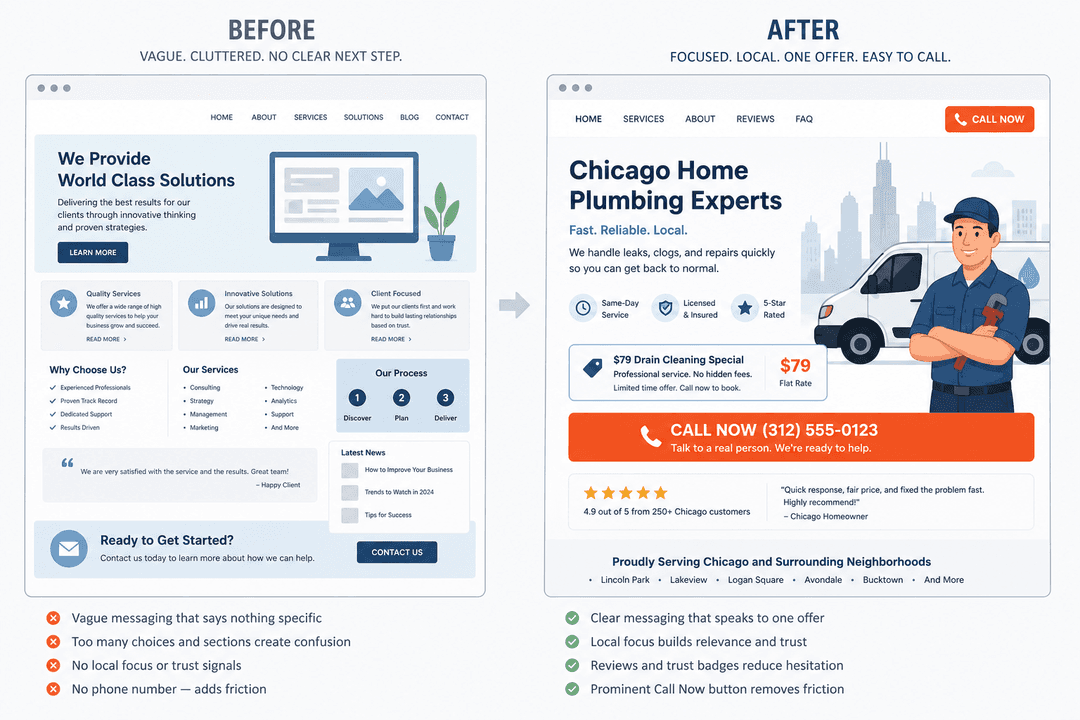
Why people bounce even after they found you
Calls are a trust decision. The visitor is buying the risk that you will show up, price fairly, and know the work. Hide that proof in the footer and they will tap the next result.
Put reviews near the top, including ones that mention the service they searched. A five-star widget that never names “crown” or “root canal” does less work on a dental landing page than three sentences from a patient who had that job done in your office.
Speed still kills this. A slow first load on a phone in a parking lot is a closed tab. We covered the business cost of that delay in The hidden cost of slow websites. You do not need a perfect PageSpeed score. You do need the hero, the number, and the first image to appear before the person gives up.
Forms are the other leak. Name, phone, what they need, and maybe a photo upload for trades. Six extra fields “for the CRM” is how you train people to call a competitor. If you need more detail, collect it after they are already in the calendar.
Trust also dies on mismatch. Ad or Google result says “same-day.” Homepage says “request a consultation.” The click was a promise. Break it and you paid for a bounce. That is the same pattern we see in Stop the drop-off and in Before the first click.
A conversion-friendly 2026 service site is boring in the best way. Clear offer. Visible number. Real photos. Fast on a phone. We keep a checklist of that in The 2026 SMB playbook.
Track calls the same way you track sessions
If you cannot see which landing page produced the ring, you will keep rewriting the wrong page.
Minimum setup for a Chicago service business:
Click-to-call events on mobile (or a call-tracking number on the money pages, as long as the number on the site matches what you show in the local pack). Form submit events. A weekly look at top landing pages versus those two conversion types.
You will usually find two or three URLs that eat traffic and produce almost nothing. Those are the rewrite list. Leave the rest of the site alone until those pages ask for the call in plain language.
Do not use “the phone felt busy” as a metric. Felt busy includes spam, existing customers, and your cousin. Tagged calls from key URLs tell you whether organic search is doing its job.
What to fix this month
Work in this order so you do not spend the budget on a new brand while the H1 still says “Welcome.”
Rewrite the homepage H1 to name the main service and Chicago (or the suburb that actually pays the bills). Put the phone number in the header as click-to-call. Add three proof points under the hero that a stranger can verify.
Open the top five Search Console landing pages. If the first screen is vague, rewrite those next, especially service URLs. Remove extra CTAs until each of those pages has one primary action.
Give each money service its own page if it still lives as a paragraph on the homepage. Link those pages from the nav with the words people search, not “Solutions.”
Then look at queries. If the pages are clear and the clicks are still all how-to traffic, shift the SEO plan toward commercial terms and the local pack. That is SEO work, not another coat of paint. Our notes on doing that with a limited budget are in How to prioritize SEO when your budget is limited.
If the site itself is the constraint (template you cannot edit, builder that fights you, no way to add service pages), that is when a custom build or a serious redesign earns the cost. How to choose a website designer in Chicago is the buying guide we send people who are at that fork. Web design is the work itself.
When the page is fine and the keywords are wrong
A clear page cannot convert a visitor who never intended to hire you. If Search Console says your top queries are definitions, tips, and “ideas,” you built an audience. You did not build a pipeline.
Keep a few educational posts if they support the services you sell. Tie each one to a service page with a specific next step, the way this post points at Chicago website design and contact. Stop publishing for volume. Google has said for years they do not have a preferred word count, and they do penalize sites that exist mainly to catch rankings.
For local businesses, the durable mix looks like this. Service pages and location pages for the work you want this month. Google Business Profile that matches those pages. A smaller set of articles that answer real questions your sales team already hears on the phone. UX that does not fight local SEO, which we unpacked in The UX local SEO connection.
If you want us to run this audit on your URLs, send the site through contact. Bring Search Console access if you have it. We will tell you which pages are getting visits without calls, and whether the next move is copy, tracking, local SEO, or the site itself. I am Lexi Turnip. This is the work we do at IntuiCo every week for Chicago owners who are tired of celebrating sessions.